
What Works in Supportive Relationships for Young People — Launching Our Two-Year Evidence Report
May 22, 2026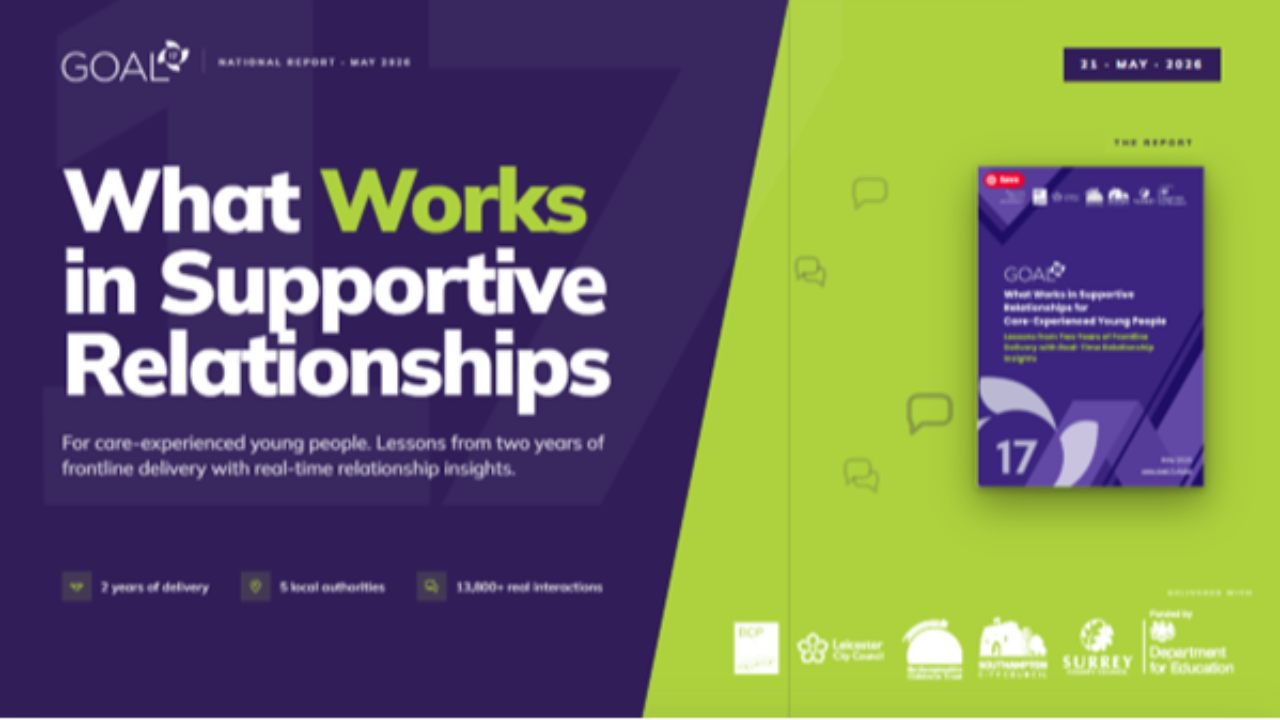
Last week, we officially launched our new report: What Works in Supportive Relationships for Young People — a two-year evidence report exploring what genuinely helps supportive relationships thrive for some of the "hardest-to-reach" young people who have experienced care.
The launch brought together over 200 local authorities, mentoring organisations, practitioners, policymakers, NHS professionals, MPs, peers, volunteers and sector leaders. All reflecting on one very important question:
What actually makes supportive relationships work — and how do we create systems that help them succeed at scale?
What makes this report different
At Goal 17, we've spent the last two years delivering mentoring and befriending programmes across five local authorities, while also developing Wowment.ai — a communication platform that connects mentors and young people in a way that is both natural for them and safe for organisations.
What makes this report different is that it doesn't rely on surveys or end-of-programme reflections. It couldn't — because care-experienced young people have been assessed, evaluated and judged their entire lives. They don't fill in forms. They don't answer surveys. And they shouldn't have to.
Instead, it combines real-world delivery experience, quantitative programme data, behavioural insights, and over 13,800 anonymised interactions between young people and their mentors — captured naturally, through the conversations that were already happening.
The result is one of the most detailed practical explorations of how supportive relationships develop in real life — particularly with young people who have experienced care.
And whilst the evidence base is drawn from care-experienced young people, the findings speak to a much wider challenge: how do we build genuine, consistent relationships with any young person who has historically been hard to reach? The barriers we identified — and the approaches that broke them down — apply far beyond the care leaver context.
What we found
The headline finding is stark. In Year 1, just 30% of young people recorded as receiving support were genuinely interacting with their mentor. Relationships that existed on paper — but not in practice.
By Year 2, after redesigning how we reach young people, where we meet them, and how trust is built, that figure became 82%.
Same cohort. Same staff. Different design.
And the outcomes that followed were remarkable:
- 69% of young people who started as NEET progressed into or towards education, employment or training — without a single direct employability target
- 1 in 8 mentoring meetings involved a crisis or safeguarding moment that was identified and de-escalated
- Young people who had been considered disengaged in Year 1 re-engaged when approached differently in Year 2
- Social value returns of between £3.30 and £8.30 for every £1 invested
Some of the key themes the report explores include:
- Why "being matched" is not the same as being meaningfully engaged
- The role of micro-connections in building trust
- How communication habits influence relationship outcomes
- Why traditional systems often unintentionally create barriers to engagement
- The importance of meeting young people where they already are
- How organisations can enable safe, consistent communication at scale through technology
- What local authorities and organisations can do differently moving forward
The conversation that keeps coming up
One of the biggest discussions during the launch centred on the difference between compliance and genuine engagement.
In many programmes nationally, success is measured by whether a young person has technically been "matched" or is "receiving support." Our findings suggest this can hide a very different reality underneath.
The Department for Education's own national evaluation — using the standard sector measure — would have shown our Year 1 performance as broadly in line with the national average. By their metric, 52% of our referred young people were receiving support, against a sector average of 62%.
But when we looked at actual interaction — were these young people genuinely talking to their mentor? — the figure was 30%.
The report explores how relationship quality, consistency, responsiveness and trust-building are far more important indicators of success than traditional top-line metrics. And it shows, for the first time, exactly what it looks like when you close that gap.
Because this was perhaps the most important line in the whole presentation:
Care-experienced young people are often described as hard to engage. Our evidence suggests a different conclusion: many services are simply hard to engage with.
Supportive relationships are not a "nice to have"
They are preventative infrastructure.
The outcomes in this report — progression into employment, crisis de-escalation, reduced isolation, housing stability — are not the result of targeted interventions. They emerged from consistent, trusted, human relationships. Relationships that happened because we removed the barriers to them.
That is the argument this report makes. And now we have the data to prove it.
Watch the recording
If you missed the live launch, you can watch the full 60-minute session — including the data, how the Wowment communication platform works in practice, the Q&A with commissioners and MPs, and the full report findings — here:
Download the full report
The complete report is also available to download from the same page. We'd encourage you to share it widely.
We hope this report contributes meaningfully to the national conversation around mentoring, supportive relationships and care-experienced young people — and to the much wider question of how we build systems that genuinely reach and support young people who have historically been left behind.
This is only the beginning of a much bigger conversation — one we're proud to continue alongside local authorities, volunteers, practitioners, researchers, and most importantly, young people themselves.
Thank you to everyone who joined us for the launch, and to everyone who continues to support this work.
Want to explore what this means for your organisation? Book a call with Fran directly.